RC INSIGHTS · RC EQUIPMENT · 2026
The car ran fine on Sunday. By Wednesday you’ve ordered a motor, a pinion and something purple made from aluminium. You’re not sure what the purple thing does, but it matches the other purple thing. Engineering. A motor upgrade deserves a slightly better plan: what do you want the model to do differently? These ten RC options cover bashers, racers, crawlers, boats and aircraft. Match the model, dimensions, shaft, battery and electronic speed controller (ESC) first. The fastest-sounding name is not a specification, and a motor that nearly fits is still a motor sitting on the bench.
Ten different jobs, ten options to investigate. This is a specification-based selection, not a ranking or a shared hands-on test. Manufacturer details were checked on 7 September 2026; confirm your exact UK version and current availability.
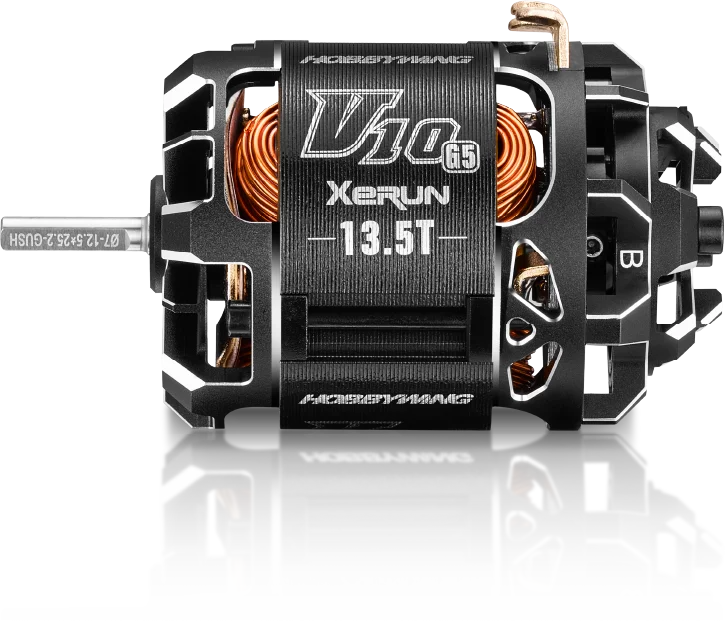
Hero photograph: Hobbywing. V10 G5 family pictured in 13.5T form; the shortlist discusses the 17.5T Torque version.
THE COMPARISON
10 motors
RC bashers, racers, crawlers, boats and aircraft.
SPEED CLAIMS
KV ≠ mph
Gearing, voltage and load determine the result.
BEFORE YOU BUY
Measure twice
Can length, shaft size and ESC compatibility come first.
The RC numbers, without the sales patter
| RC equipment | Worth considering for | Key specification |
|---|---|---|
| Tamiya RS-540 Sports Tuned | RC kit builders keeping things simple | 23T brushed; 6–8.4V; manufacturer maximum 18,300rpm at 7.2V |
| Hobbywing QuicRun 3652SL G2 4000KV | Light-duty RC buggies and road cars | 4000KV; sensorless brushless; 2–3S; 36 × 52mm; 3.175mm shaft |
| Hobbywing QuicRun Fusion SE 1800KV | RC crawling with less wiring | 1800KV; integrated 40A ESC; 2–3S; 36 × 58.1mm |
| Hobbywing QuicRun Fusion Pro Elite | RC crawlers with a tighter motor bay | 2300KV; integrated 50A ESC; 2–4S; 37 × 48.5mm |
| Hobbywing XeRun V10 G5 17.5T Torque | RC stock-class racing | 17.5T; sensored brushless; 3000KV nominal; 35.8 × 51.5mm; 138g |
| Castle 1415 2400KV Sensored | RC short-course trucks and rock racers | 2400KV; 3–4S; 36 × 69.5mm; 3.17mm shaft; 318g with wires |
| Castle 1515 2200KV V2 Sensored | Larger RC bashers and 1/8 builds | 2200KV; 2–6S; 75.4mm long; 41.4mm over fins; 5mm shaft |
| Hobbywing XeRun 4274 G3 2250KV | RC 1/8 truggies and larger off-road projects | 2250KV; sensored; 2–6S; 42 × 74mm; 5mm shaft; 354g |
| Hobbywing SeaKing 3660 SL V2 2600KV | RC boat builds with proper water cooling | 2600KV version; marine sensorless brushless motor; water-cooling jacket |
| E-flite Power 10 1100KV | RC sport and scale aircraft | 1100KV outrunner; 2–3S; 5mm shaft; up to 450W application class |
1. Tamiya RS-540 Sports Tuned
A compatible Tamiya and a Sports Tuned brushed motor can be an appealingly straightforward project. No need to turn every classic into a frantic demonstration of why the rest of its drivetrain had been enjoying a quiet life. Check the chassis list and ESC limit, fit the full ball bearings Tamiya calls for and set the gear mesh properly. The interest here is an understandable upgrade for an appropriate build, not a contest with every brushless conversion online. A model you enjoy driving is the goal. You don’t have to frighten the gearbox to achieve it.
Check before buying: Check the chassis compatibility list and ESC motor limit. The quoted rpm is a manufacturer figure, not a vehicle top speed.
2. Hobbywing QuicRun 3652SL G2 4000KV
The QuicRun 3652SL G2 4000KV is worth investigating for a suitable light-duty buggy or road car. The compact can helps where space is tight, but the motor’s 2–3S specification isn’t permission to feed every connected component 3S. Check the controller and drivetrain as well. Start with gearing suited to the application and pay attention to load. Tall grass and enormous tyres can turn a simple conversion into an extremely expensive hand warmer. More power is enjoyable when the complete model is set up for it; the motor cannot organise that by itself.
Check before buying: Match the exact 4000KV version: the 5400KV variant has a different voltage limit. Check ESC compatibility as well as motor fit.
3. Hobbywing QuicRun Fusion SE 1800KV
The Fusion SE combines crawler motor and ESC, reducing the collection of boxes and wires you need to hide under the body. A tidy installation is a genuine attraction when the existing chassis looks as though someone dropped a plate of spaghetti in it. Its field-oriented control, or FOC, is aimed at managing low-speed movement under changing load. The 1800KV version belongs in a suitable trail build where controlled starts matter. It’s a different job from choosing a high-KV basher motor, because the satisfying bit may be moving one tyre half an inch.
Check before buying: This is a complete motor/ESC unit. Check length, battery connector and servo voltage before replacing existing electronics.
4. Hobbywing QuicRun Fusion Pro Elite
The Fusion Pro Elite offers a shorter combined motor-and-ESC package and more setup options. That’s interesting when a crawler’s transmission, links and body have already booked most of the available space. Check diameter and cable clearance as well as length; a short component can still fail to fit sideways. The adjustable BEC—the supply feeding radio equipment and servos—needs an output voltage all connected devices support. This is a useful place for careful reading. “More volts sounds better” is not a setting, however enthusiastically it’s delivered.
Check before buying: The BEC has selectable output voltages; use one supported by every connected servo and accessory. A 4S motor rating is not a 4S approval for your whole model.
5. Hobbywing XeRun V10 G5 17.5T Torque
Stock racing can make very small adjustments feel enormously important. The V10 G5 17.5T Torque belongs in that conversation where its exact specification and approval suit the class. Ask the organiser about motor lists and timing before ordering. A beautifully engineered motor you’re not allowed to race is mainly a sophisticated ornament. Its serviceable design and sensor arrangement will interest racers who like understanding the setup. Choose it for the rules and job you have, rather than assuming the part name can file your entry and find the racing line for you.
Check before buying: Confirm the exact motor is permitted by your organiser. Manufacturer voltage capability does not override class battery and timing rules.
6. Castle 1415 2400KV Sensored
The Castle 1415 2400KV sensored motor is a longer-can option for suitable short-course and rock-racing applications within Castle’s guidance. Sensored operation can help with smooth starts when the controller supports it. Measure length, diameter and wire clearance properly. The exact listing here uses a 3.17mm shaft; there’s also a 5mm version. This is the point at which reading a part number saves you buying a pinion that is either impressively loose or absolutely determined not to fit. A neat matched installation beats an afternoon of staring at incompatible round holes.
Check before buying: This listing is the 3.17mm shaft version, part 060-0060-00. Castle also sells a 5mm version; buy the correct pinion bore.
7. Castle 1515 2200KV V2 Sensored
The 1515 2200KV V2 is for an appropriately sized RC build and a power system chosen to work together. It is not a casual answer to “could my little car be faster?” unless the rest of that sentence includes a great deal of engineering. Follow Castle’s application and weight guidance, check the finned housing clearance and match the ESC, battery and connectors. Use the actual V2 dimensions. The motor’s voltage ceiling doesn’t approve every gearing combination, and a temperature check is more useful than admiring the upgrade while it quietly gets unhappy.
Check before buying: Use the V2 dimensions and application limits. Its 6S ceiling does not mean every gearing or vehicle combination is suitable at that voltage.
8. Hobbywing XeRun 4274 G3 2250KV
A larger truggy asks its motor for repeated acceleration and plenty of work through substantial tyres. The XeRun 4274 G3 is aimed at that sort of 1/8 off-road application. A suitable XR8 controller provides access to the intended sensored system features, so research the combination rather than treating electronics like a lucky dip. Check mounting, pinion bore and cooling space. For competition, follow the class rules and establish a repeatable setup before chasing aggressive settings. A spectacular first straight is less useful if the remainder of the race becomes an inspection opportunity.
Check before buying: Check pinion bore, mounting clearance and ESC support. The stated dust protection is not a promise that the motor is waterproof.
9. Hobbywing SeaKing 3660 SL V2 2600KV
The SeaKing 3660 SL V2 belongs in a properly planned RC boat installation. We’re discussing the 2600KV option; the family also includes another winding, and that difference matters. Match hull, voltage, propeller, coupling and water cooling from the manual. A boat is an awkward place to improvise a car-style conversion because the troubleshooting bench may be thirty metres from shore. Reliable water flow is part of the system, not a decorative extra. The useful upgrade is a combination that suits the hull, rather than the motor with the most excitable number.
Check before buying: Confirm the exact voltage, propeller and ESC combination in the 3660 V2 manual. Do not transfer limits from another SeaKing size.
10. E-flite Power 10 1100KV
For an aircraft, start with the airframe and propeller rather than a desire to win the motor table. The Power 10 1100KV outrunner is an option for suitable sport and scale applications within E-flite’s guidance. Check mounting, aircraft weight, balance and propeller clearance, then verify the load and current of the actual combination. A motor cannot be sensibly compared with a truck motor by KV alone. It would be like choosing a kettle by how much you like its tyres. Match the system and make the aircraft pleasant to operate.
Check before buying: The official specification recommends 2–3S, not 4S. Select the propeller and ESC together; the 450W figure is not guaranteed output in every installation.
RC motor KV: big number, incomplete story
KV describes the motor’s approximate unloaded revolutions per minute per volt. Vehicle speed also depends on gearing, tyre diameter, load, battery voltage and losses. A boat or aircraft adds propeller choice to the calculation. That is why we have used meaningful KV, size and application highlights instead of inventing mph figures for loose motors. Choose the combination recommended for your model, then refine it in manageable steps.
Make the RC components get along
Before ordering, write down the motor diameter and length, shaft size, mounting pattern, ESC type and battery voltage. Sensored features require a compatible ESC and connection; brushed and brushless controllers are different. Check how much room the wires need too. For a conversion, include the cost of a suitable pinion, connectors and any supporting drivetrain work. A motor that physically fits can still be the wrong electrical match.
First RC run: find out, don’t show off
Use the manufacturer’s starting recommendations, inspect the installation and begin with short runs while checking temperature. Do not solve overheating by repeatedly trying another full-throttle pass. For an aircraft, verify the actual propeller load and current; for a boat, confirm the cooling arrangement before launch. For racing, ask the organiser about the permitted motor and settings before spending money. Stop if the setup is overheating and resolve the cause before another run.
Still happily browsing RC kit?
Compare these choices with the RCnews car buying guides, browse RC Insights or find a UK RC club where you can ask what works in the models you actually use.
What are you trying to fix?
“More power” sounds like a plan until you ask where the current setup falls short. Is the start too abrupt? Is the model struggling with the intended load? Are you buying for a defined race class, or simply itchy because a parcel hasn’t arrived this week? Be honest. The last one is understandable, but it isn’t a motor specification.
Write down the behaviour you want to change. Then compare the motor, controller and gearing around that job. If the existing drivetrain is binding or the tyres are wrong for the surface, fitting a different motor may leave the real problem untouched. It can even make that problem more expensive.
Measure the annoying bits as well
Can length and diameter are only the beginning. Look at the shaft, mounting holes, pinion, connectors and where the wires emerge. Leave room to assemble and inspect the installation. A component that fits only when you can no longer reach its connections has introduced a fresh hobby: dismantling half the car for access.
Check the exact variant. Similar product names can cover different shafts, windings and limits. Save the part number and manual together, so a later spare order doesn’t depend on remembering which of several nearly identical versions you bought.
Make the first run tell you something
Use the manufacturer’s starting guidance and change one thing at a time. Record the gearing, battery and conditions. Short checks let you spot an issue before asking for a full session, and they give you a baseline for later adjustments.
If it overheats, stop and resolve the cause. Another fast pass is not a diagnostic tool. Check loading, gearing, installation and the specified cooling arrangement as appropriate to the model. The technical side can stay straightforward even when the rest of the hobby is gloriously daft.
The satisfying result is a model that does its intended job better: a crawler that starts smoothly, a racer with a compliant repeatable setup, or a suitably powered boat or aircraft. That’s worth spending on. A new motor bought purely to make the specifications more dramatic may deliver a great deal of excitement, but not necessarily the kind you wanted on a Sunday afternoon.