RC INSIGHTS · RC EQUIPMENT · 2026
There are few RC disappointments quite like a fully charged new battery that doesn’t fit the car. You turn it sideways. Try again. Look at the tray as if it’s changed shape to spite you. It hasn’t. These ten RC batteries cover different jobs, from classics to larger trucks, racers and aircraft. Start with chemistry, voltage, dimensions and connector before capacity. LiPo means lithium-polymer; NiMH means nickel-metal hydride. They need the right charging arrangements. The label can be exciting later. First, let’s make sure the expensive little brick belongs in the model you own.
Ten different jobs, ten options to investigate. This is a specification-based selection, not a ranking or a shared hands-on test. Manufacturer details were checked on 7 September 2026; confirm your exact UK version and current availability.
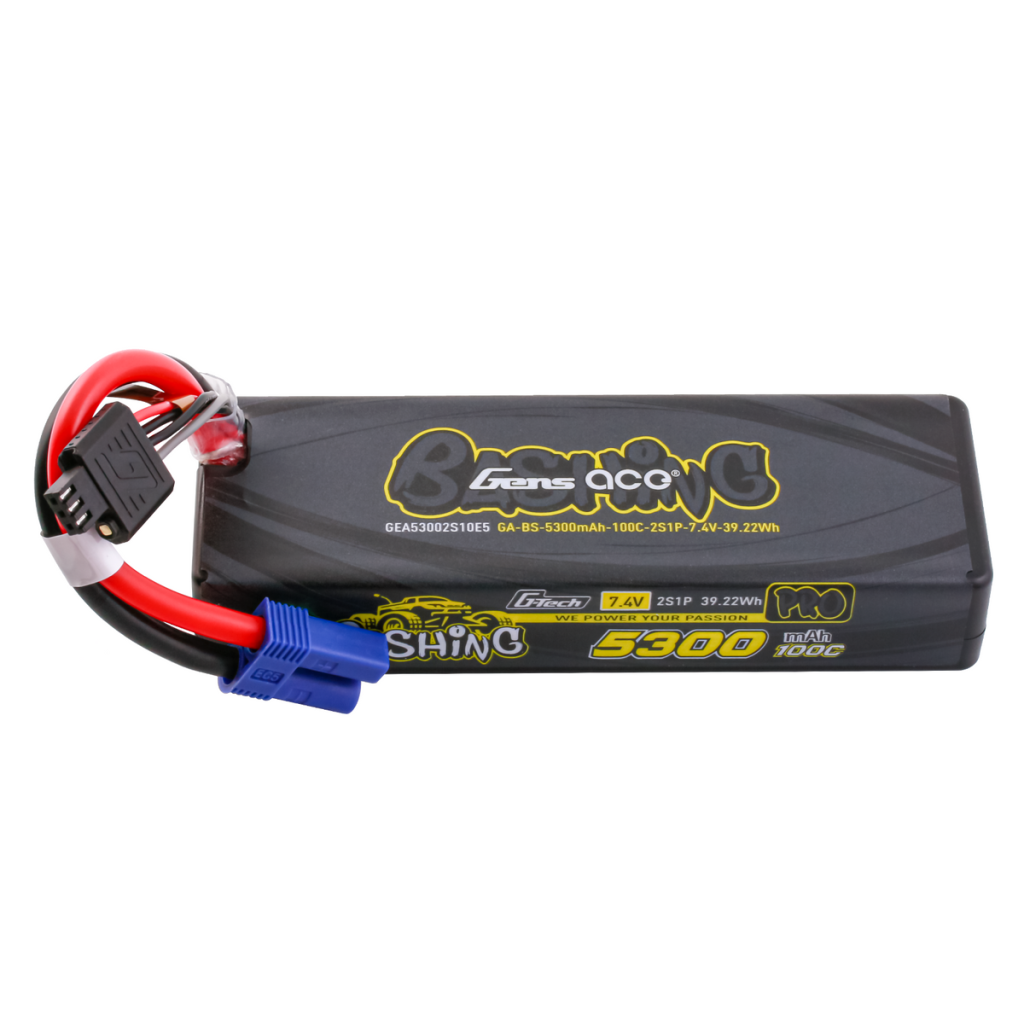
Hero photograph: Gens ace. Shown as one example from this guide.
THE COMPARISON
10 packs
LiPo and NiMH choices for different RC models.
FIRST CHECK
Voltage + fit
Cell count, chemistry, dimensions and connector.
C RATINGS
Claimed figures
A label is not an independent performance test.
The RC numbers, without the sales patter
| RC equipment | Worth considering for | Key specification |
|---|---|---|
| Gens ace G-Tech 5300mAh 2S Bashing | Everyday RC surface use where the pack fits | 7.4V; 5300mAh; 100C claimed; EC5; 138 × 46 × 24mm |
| Gens ace G-Tech 6500mAh 3S Bashing | RC bashers with room for extra capacity | 11.1V; 6500mAh; 60C claimed; EC5; 154 × 47 × 26mm |
| Gens ace G-Tech 6800mAh 4S Bashing | Large RC vehicles with a suitable battery bay | 14.8V; 6800mAh; 120C claimed; EC5; about 159 × 47 × 42mm |
| Gens ace Redline 2.0 4000mAh Shorty | RC racing chassis designed for a shorty pack | 2S; 7.4V; 4000mAh; 140C claimed; 5mm bullet connections |
| Gens ace G-Tech Soaring 2200mAh 3S | Compatible RC trainers and sport aircraft | 11.1V; 2200mAh; 30C claimed; XT60; about 174g |
| Tattu R-Line V5 1550mAh 6S | Compatible RC FPV racing and freestyle builds | 22.2V; 1550mAh; 150C claimed; XT60; about 250g |
| Traxxas Power Cell iD 5000mAh 3S — 2872X | Compatible Traxxas RC models using iD charging | 11.1V; 5000mAh; 25C claimed; Traxxas iD |
| Traxxas Power Cell iD 5800mAh 2S — 2843X | Compatible RC models staying on 2S | 7.4V; 5800mAh; 25C claimed; Traxxas iD |
| Traxxas Power Cell iD 6700mAh 4S — 2890X | Compatible larger Traxxas RC vehicles | 14.8V; 6700mAh; 25C claimed; Traxxas iD |
| Overlander Premium Sport 3300mAh 7.2V NiMH | Compatible RC classics and straightforward stick-pack setups | 7.2V; 3300mAh; six-cell NiMH; connector options vary |
1. Gens ace G-Tech 5300mAh 2S Bashing
The G-Tech 5300mAh 2S Bashing is a surface-use option where the model supports its specification and the hard case fits properly. That last part sounds obvious, right up to the moment a strap won’t close. Use the published dimensions, allow room for the leads and include the roughly 276g weight in your thinking. Battery position affects how a car feels, not just how long it stays out. This is a candidate for a compatible everyday setup, not a universal replacement for anything rectangular that used to live in the battery tray.
Check before buying: Check the EC5 connection and tray dimensions. A hard case helps protect the cells but does not make the battery impact-proof.
2. Gens ace G-Tech 6500mAh 3S Bashing
The 6500mAh 3S G-Tech offers capacity for an RC that already supports 3S and has room for the pack. It does not offer a persuasive argument to a 2S-only controller. The listed soft-case size and approximately 421g weight give you something concrete to check before buying. More capacity brings more mass along, so judge the complete installation. Secure it as intended and leave the leads space. The aim is more usable driving, not an impressively labelled battery balanced awkwardly in a tray while you consider increasingly optimistic solutions.
Check before buying: Leave space for the leads and secure the soft case properly. Match the model’s voltage limit before considering capacity.
3. Gens ace G-Tech 6800mAh 4S Bashing
The 6800mAh 4S Bashing pack is a sizeable battery for a suitable large-model installation, with about 673g listed for this version. That’s enough reason to take tray depth, straps and balance seriously. We’ve included it for the appropriate power system, not as a compulsory next level in the hobby. Follow the model’s arrangement, particularly with paired packs. This exact version is GEA684S12E5GT; older packs with similar names can differ. A precise stock code is dull conversation, but excellent protection against an expensive game of battery-shaped roulette.
Check before buying: These figures are for GEA684S12E5GT. Older 6800mAh versions can have different dimensions and weight; compare the exact SKU.
4. Gens ace Redline 2.0 4000mAh Shorty
A shorty racing pack is a chassis choice as well as an electrical one. The Redline 2.0 4000mAh belongs in a suitable car and permitted class, where its format and placement make sense. Check event approval, race duration and the correct charge limits. The C rating is not a promise to sort out your lap time while you continue braking at the scenery. Tyres and driving still matter. Confirm the bullet connections and polarity carefully, and don’t assume an HV charge setting from the family name: this linked pack is specified at 7.4V.
Check before buying: Confirm race approval, charge-voltage rules and bullet polarity. The linked pack is specified at 7.4V; do not assume it is an HV version.
5. Gens ace G-Tech Soaring 2200mAh 3S
A 2200mAh 3S pack is familiar in flying, but familiar isn’t the same as compatible. The Soaring version’s published size lets you check the bay properly. Match the aircraft’s requirements and establish the centre of gravity with the pack installed. An extra minute sounds attractive until the battery position has made the aircraft less pleasant to fly. Choose around the whole airframe, not just a capacity figure. Your aeroplane would very much like the balance question answered before take-off, rather than discussed in an increasingly high-pitched voice afterwards.
Check before buying: Check the aircraft’s required capacity, current capability, connector and centre of gravity. Other 2200mAh Soaring versions differ.
6. Tattu R-Line V5 1550mAh 6S
The Tattu R-Line V5 1550mAh 6S is a specialist option for a compatible first-person-view (FPV) build. Check its approximate 76 × 39 × 46mm dimensions and 250g weight against the frame and intended setup. We’ve included V5 for that job, not because every older generation vanishes when a newer one appears. Verify current stock and exact version. A 6S label is not a statement about how serious you are as a pilot; it’s a compatibility requirement that the whole system needs to support. Choose the battery around the build.
Check before buying: Only use in a 6S-compatible system. Check current stock and the exact version; the source listing showed variable availability when researched.
7. Traxxas Power Cell iD 5000mAh 3S — 2872X
Already using suitable Traxxas iD charging equipment? The 2872X 5000mAh 3S pack may make the next purchase straightforward, provided your exact model supports it. Start with the fit guide rather than assuming all Traxxas battery trays attended the same design meeting. The attraction is a matched connector and charging arrangement. Compare complete costs if you’re considering another route, including any charging changes. The cheapest standalone pack doesn’t always make the cheapest system, and a matching-looking plug is not a substitute for confirming the equipment works together.
Check before buying: Use a charger that properly supports this iD pack. A matching plug alone does not establish charging or vehicle compatibility.
8. Traxxas Power Cell iD 5800mAh 2S — 2843X
Staying on 2S is allowed. There’s no examiner waiting to ask why you haven’t bought more voltage yet. The 2843X 5800mAh pack is an option for a compatible model where you want the familiar iD arrangement and its capacity suits the job. Check physical fit and weight rather than assuming a larger mAh figure automatically improves everything. Driving style has plenty to say about runtime too. Choose the pack that makes your normal session work well, even if that session is mostly practising corners and cheerfully getting them wrong.
Check before buying: Confirm 2843X appears in your exact model’s fit information. Capacity alone does not establish whether a battery fits the tray.
9. Traxxas Power Cell iD 6700mAh 4S — 2890X
The 2890X 6700mAh 4S belongs with the larger compatible Traxxas setups it is specified for. It is not a universal upgrade because the connector looks reassuringly familiar. Check the required number of packs, their arrangement, the tray and the charger’s cell-count support. This is the sort of purchase where a few minutes with the fit information can save a very quiet unboxing followed by a return request. Get the whole system right and the charging routine can stay simple. Guess and you’ve bought yourself an object to research after paying for it.
Check before buying: Never substitute it in a 2S- or 3S-only vehicle. Verify tray dimensions and the charger’s supported cell count.
10. Overlander Premium Sport 3300mAh 7.2V NiMH
A compatible classic or brushed model may be perfectly happy with a suitable NiMH stick pack. The Overlander Premium Sport 3300mAh 7.2V option gives that job a place here alongside the LiPos. Newer chemistry is not an instruction to convert everything you own. Check the case arrangement, connector and a NiMH-compatible charging programme. Flat stick and offset-hump versions are different items. The appeal is a straightforward setup for the right model, rather than winning an argument about technology while the car sits on the shelf waiting for another conversion part.
Check before buying: Use a NiMH-compatible charging programme. The flat stick and offset-hump versions are different products; choose the correct format.
RC battery voltage: get this right first
The cell count and chemistry must match the model’s requirements. A higher-capacity pack at the correct voltage may offer more usable time, but adds weight and may not fit. Raising voltage is a different change and can damage an unsuitable power system. Check the exact vehicle or aircraft manual, not a similar-looking model online. For boats, use the specified battery type and arrangement; do not assume any pack that fits the hull will do.
RC battery C ratings: labels aren’t lap times
C rating describes a claimed discharge capability relative to capacity. It is not a measured ranking of real-world performance across brands, and we have not independently load-tested these packs. Treat it alongside the manufacturer’s application guidance, connector specification and actual model demand. Capacity in mAh is also not a guaranteed runtime: driving style, terrain, gearing, aircraft setup and battery condition all affect how long a session lasts.
The RC charger belongs in the plan
Match the charger to the chemistry, cell count, balance connection and manufacturer’s charging instructions. Smart systems differ: support for one brand’s automatic features does not imply support for another’s. Standard LiPo and high-voltage LiPo settings are not interchangeable. Never leave charging batteries unattended, and stop using a pack that is swollen, damaged or behaving abnormally. Let batteries cool after use and follow the maker’s storage guidance. A suitable charger and a careful routine are part of the purchase, not optional extras.
Will the RC battery actually fit?
Measure the available length, width and height, including room for the leads. Check how the strap or hold-down secures the pack without crushing it. In an aircraft, confirm the centre of gravity with the new battery installed. On an RC racer, check pack format and competition requirements. If you use matched pairs, follow the model and battery maker’s guidance for the pair. Ask your RC shop to confirm the exact SKU when product names look almost identical.
Still happily browsing RC kit?
Compare these choices with the RCnews car buying guides, browse RC Insights or find a UK RC club where you can ask what works in the models you actually use.
Give the battery drawer a little organisation
Keep the exact pack details and matching model information somewhere clear. When several batteries look alike, memory is a poor labelling system. Follow the maker’s care and storage instructions, and keep the correct charging information with the equipment.
That doesn’t require a workshop worthy of a magazine photograph. It requires being able to identify what you’re using without guessing. If you share the hobby, make the setup understandable to the next person too. “I know which one it is” works beautifully until you’re not the person standing there.
Buy for a normal session
Think about how you actually use the model. Several shorter runs, a race heat and an aircraft flight ask different things of the battery plan. A large-capacity pack may be useful if it fits and meets the requirements; it may also add weight you don’t want. Bigger isn’t automatically better simply because the label has found more digits.
Look at the full setup cost and charging arrangements before adding another pack. More batteries are only convenient when you can manage them properly. A growing collection of nearly compatible packs is less a power system and more a small museum of previous shopping decisions.
Make the fit check boringly thorough
Measure all three dimensions, not just the one that looks tight. Allow space for connectors and leads, and confirm the retention system works without squeezing or damaging the pack. Check the exact SKU if the retailer stocks several versions with similar names.
For aircraft, balance the model with the new pack installed. For racing, check the permitted format and charging limits. For a paired arrangement, follow the manufacturer’s requirements for the pair. These are different jobs, so a battery recommendation from another model is only a starting point for questions.
The jokes stop at charging instructions
Use the correct chemistry, cell count and settings, and follow the manufacturer’s instructions. Don’t leave charging batteries unattended. Stop using a damaged, swollen or abnormal pack and follow appropriate manufacturer guidance. Charging and storage deserve clear instructions rather than a clever shortcut.
Once those basics are sorted, the useful outcome is simple: a model you can take out with confidence in its setup. The best battery purchase may be the one you barely think about during the session because it fits, works with your equipment and suits the job. That leaves plenty of attention for the corner you’re still blaming on the tyres.