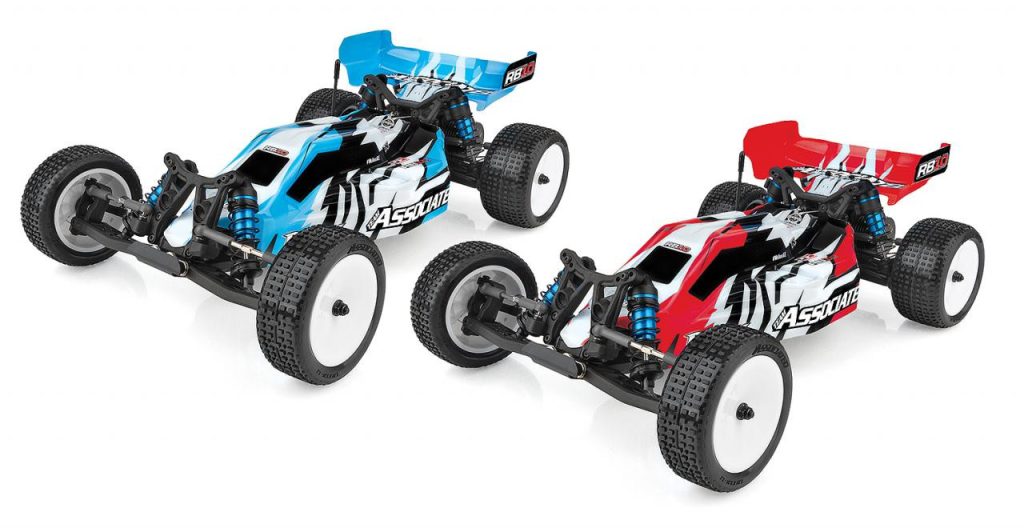
The Team Associated RB10 is a ready-built rear-wheel-drive RC buggy, which means you can skip the kit build and get straight to the important business of discovering what your trigger finger thinks a corner is. Early evidence may suggest it believes corners are optional.
SPEED / PACE
31 mph
AMain measured on 3S; 20 mph on 2S in that test.
RC TYPE
RC Buggy / Club Starter
Choose the vehicle for the way you drive.
WHY IT STANDS OUT
2WD
Learn the art of a clean RC exit
Hero image: Team Associated. Manufacturer product photography; colours and supplied equipment can vary.
A buggy can be a lovely way to get absorbed in the driving itself. Find suitable ground, work on a repeatable line and suddenly a clean exit feels like an achievement. You don’t need to enter a championship to enjoy that. You do need to pick the car and tyres for the surface you’ll actually use.
The badge doesn’t enter the race for you
Team Associated has a recognisable racing background, but this is still a specific ready-to-run model with a specific equipment package. If club racing is your reason for buying, ask the club about the RB10 before ordering. A famous name on a box is not a completed entry form.
Associated lists a Reedy 3300Kv brushless motor, adjustable DVC gyro receiver, aluminium 12 mm shocks, a sealed gear differential and an adjustable slipper clutch. The rear-wheel-drive chassis accepts suitable NiMH or 2S–3S LiPo packs. Vehicle-only and LiPo Combo versions differ, so check the exact contents. The product page supplies the technical table and current package information.
AMain’s test measured 20 mph on 2S and 31 mph on 3S. Those are that retailer’s GPS results for its test setup, not manufacturer guarantees or RCnews measurements. We have used that distinction in the speed graphic because a properly attributed number is more useful than an unexplained “up to”.
Read the surface as well as the verdict
RC CARS 2026 · THE RCNEWS SHORTLIST
RC terms used in this guide: ready-to-run (RTR) means the model is assembled; check which equipment is supplied. An electronic speed controller (ESC) controls motor power. LiPo means lithium-polymer battery, and the S number describes cells in series. Kv is approximate unloaded motor revolutions per minute per volt, not vehicle speed.
Researched RC buying guide. RCnews has not tested this vehicle hands-on. Manufacturer specifications and published reviews were checked on 6 September 2026.
Hero image: Team Associated . Manufacturer product photography; colours and supplied equipment can vary.
SPEED / PACE
31 mph
AMain measured on 3S; 20 mph on 2S in that test.
RC TYPE
RC Buggy / Club Starter
Choose the vehicle for the way you drive.
WHY IT STANDS OUT
2WD
Learn the art of a clean RC exit
The Team Associated RB10 is a ready-built, rear-wheel-drive RC buggy for drivers who want to learn more about grip and throttle control. It removes the initial kit build, but choosing the right surface and tyres still matters. If club racing is the plan, check the rules before ordering; the racing name on the box cannot enter the meeting for you.
This is a ready-to-run buggy with a recognisable racing family background, but the badge does not remove the need to choose the right car for your local track. Its appeal is as an accessible starting point for buggy driving and a possible introduction to club activity, subject to the club’s rules.
Browse all ten RC cars for 2026 →
Those observations make tyre and surface choice worth attention. A setup used on carpet isn’t automatically the answer for outdoor ground, and a tyre that lasts well isn’t necessarily the tyre that provides the most grip at your venue. Start with the job rather than the most impressive-looking tread.
The rear wheels have opinions
Rear-wheel drive rewards a bit of thought about when you ask for power. If you’re untidy, that can become part of the challenge rather than a reason to dismiss the car. Give yourself a comfortable approach speed, one broad turn and a clear exit to aim for.
Repeat it before changing settings. Were you faster on entry? Did you add throttle sooner? Did you suddenly wind in more steering because the marker looked closer than expected? Sometimes the component causing the variation is the person holding the transmitter. Awkward warranty claim, that one.
Once the first corner feels repeatable, link it to another. A smooth run starts looking and feeling more satisfying than a frantic one. You’re making decisions rather than simply reacting to them, which is a nice upgrade and doesn’t require postage.
A gyro is a setting to understand
The adjustable DVC assistance and the observations in the published test are reasons to learn the radio setup properly. Find out what the control does, follow the instructions and make considered changes. Randomly winding a dial until something different happens is an experiment, but not a very well recorded one.
If you’re going racing, ask whether the aid must be disabled and how to comply with that class’s requirements. The organiser’s answer matters more than somebody online assuring you that “everyone runs it”. Different venues and classes can have different arrangements.
The aim is a car you understand. Assistance can be useful within its intended role, but it doesn’t replace choosing a line or learning how your inputs affect the buggy. Your thumbs still need to attend the session.
Visit the club before buying the entire pit table
Ask about classes, tyres, batteries, transponders and newcomer practice. A short visit can tell you whether this model makes sense locally or whether another car would be easier to support. Either answer is valuable before you’ve ordered everything in the matching colour.
Watch what happens between runs. How do drivers check the cars? Where do people stand? What’s the retrieval routine? The little practical details can make a first meeting feel welcoming instead of bewildering.
And there’s no need to arrive pretending you already know. A sensible question saves time. Most of the hobby is people learning things, then forgetting where they put the tool needed to do them.
Grass is not just a softer track
AMain’s taller-grass experience is a useful prompt to look carefully at your own ground. If that’s the only regular venue, a lower buggy may not give you the afternoon you pictured. Firm, suitable ground or a prepared track is a different proposition.
Choose tyres with that surface in mind. Ask for advice specific to where you run, rather than buying the most aggressive-looking pattern and hoping it sorts everything out. The tyre doesn’t know you chose it because it looked fast.
Use the standard setup to establish a baseline unless the venue requires a change. Then experiment deliberately. One adjustment on the same route can teach you something; a whole basket of parts installed together can make you very busy while explaining very little.
Check the package before unboxing day
Vehicle-only and LiPo Combo versions are different offers. Confirm the included battery, charging equipment and transmitter-battery requirements for the exact listing. A lower price is less exciting when the first session depends on another parcel.
Keep the correct manual and model details somewhere handy. Inspect after running, deal with loose or damaged parts and organise the small hardware when you work. A tidy tray won’t make you faster, but it may save you an hour negotiating with the carpet.
Build a little maintenance allowance into the budget. Not because the model needs a gloomy introduction, but because wearing and replacing parts is ordinary ownership. Knowing the cost beforehand lets you enjoy driving without treating each mark as a financial event.
Our take on the RB10
The RB10 is worth a look if you want a ready-built buggy and have suitable ground or a supporting club. Its appeal is the chance to learn the driving, rather than the promise that the badge will do it for you.
Start with clean corners, keep the setup understandable and give yourself time. When you finally link a tidy lap, you’ll know why people get hooked. Naturally, the next lap may be a complete mess. That’s the hobby keeping your victory speech to a reasonable length.
RC terms used in this guide: ready-to-run (RTR) means the model is assembled; check which equipment is supplied. An electronic speed controller (ESC) controls motor power. LiPo means lithium-polymer battery, and the S number describes cells in series. Kv is approximate unloaded motor revolutions per minute per volt, not vehicle speed.
Guide basis: manufacturer specifications and attributed published reviews, checked on 6 September 2026. This is not a comparative hands-on RCnews test.
RC technical specifications
| Specification | Detail |
|---|---|
| Model | Team Associated RB10 RTR |
| Scale / drive | 1/10 / rear-wheel drive |
| Motor | Reedy 3300Kv brushless |
| Stability aid | DVC adjustable receiver gyro |
| Shocks | 12 mm aluminium big-bore |
| Gearbox ratio | 2.6:1 |
| Drivetrain | Sealed gear differential; adjustable slipper |
| Battery options | 6-cell NiMH or 2S–3S LiPo; T-plug |
| Versions | Vehicle-only or LiPo Combo; check contents |
Source: official product specification. Check the exact model code, UK availability and retailer package before ordering. Prices are not fixed in this guide.
Fancy a closer look at the RC kit?
AMain Hobbies: RB10 driving and GPS speed test ↗
Different RC jobs call for different cars. This selection includes established models available for 2026; it is not a ranking or a claim that they all launched this year. Older reviews are labelled by generation.
More RC buying guides · Find UK RC clubs · Explore RC Insights