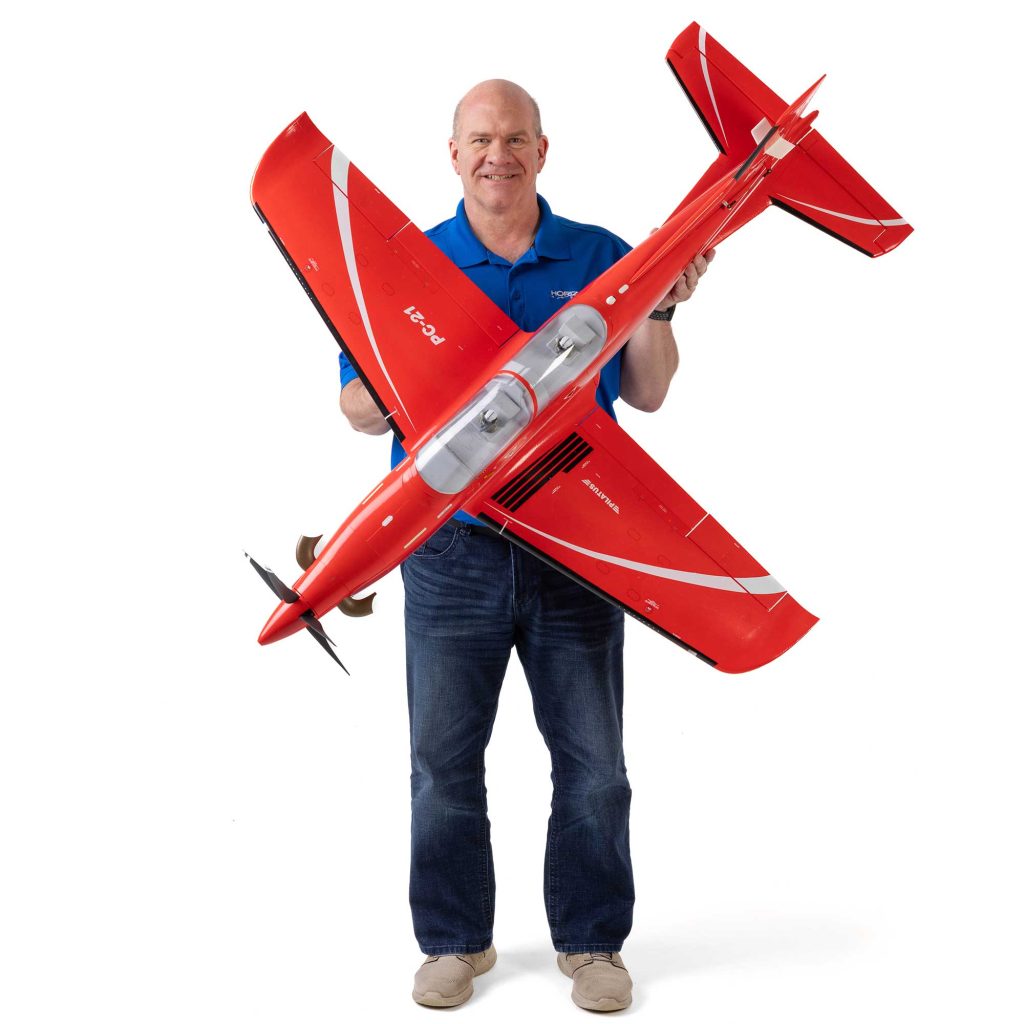
E-flite has listed the Pilatus PC-21 1.3m for release on 16 September 2026. It’s the sort of RC aircraft that can turn “just browsing” into a lengthy examination of available storage space. “It’ll fit if I move that” is how perfectly respectable sheds end up looking like aircraft carriers. Before the looks win the argument, though, there’s an important detail: this one is aimed at experienced pilots.
The PNP version, EFL14975, is rated skill level four by Horizon. PNP means Plug-N-Play: some equipment is installed, but you still supply the radio system and power equipment. The US page lists $469.99. UK pricing and arrival dates need confirming locally; an American release date isn’t a promise that your shop will have a box waiting that morning.
“Trainer” needs a bit of context
The full-size PC-21 is an advanced trainer. That doesn’t make this model a beginner’s RC trainer, any more than putting a learner badge on something would change its performance. E-flite advertises 100+ mph capability on a 6S battery. We haven’t flown or timed it, so that remains a manufacturer claim.
The listed equipment includes seven metal-geared servos, a brushless motor and a 100A electronic speed controller (ESC). The ESC regulates power to the motor. You add a full-range transmitter and receiver with at least six channels, a compatible charger and a specified 4000–7000mAh 6S lithium-polymer (LiPo) pack with an EC5 or IC5 connector.
A model to grow towards, not rush into
For an experienced pilot, there’s an obvious appeal in an aircraft that offers scale looks and a more demanding flying prospect. For somebody still getting comfortable with a basic trainer, the better plan is to keep building those skills. It’s much easier to enjoy a new aeroplane when the whole flight isn’t a private argument about how you’re going to land it.
That isn’t gatekeeping. We want you to have the satisfying version of the afternoon. A model that suits your current flying gives you room to make progress; one that gets ahead of you can turn every outing into a tense performance. The PC-21 can remain on the wish list while you get the foundations nailed.
And there’s nothing second-rate about a neat circuit in a familiar trainer. Learning to put the aircraft where you intend is the point. Buying a faster aeroplane doesn’t buy the muscle memory, inconvenient though that is for the “new model will solve it” theory.
PNP suits a radio system you already know
Choosing your own receiver can make sense if you’re already invested in a transmitter. You aren’t paying for a second complete radio arrangement simply because it came in the box. But check the receiver, available outputs and programming against the exact aircraft’s instructions.
A spare receiver in the drawer isn’t automatically the right one. Neither is a feature you’ve seen demonstrated in a video of another package automatically included in this version. Assistance functions depend on the equipment and setup being used. It’s worth untangling that before you order, while everything is still comfortably stationary.
Build the transmitter model carefully, label it clearly and work through the control checks. Familiarity with another aircraft helps, but copying a setup blindly is a good way to inherit settings you didn’t mean to bring along. Treat the programming as part of getting to know the model.
Batteries: capacity isn’t the whole story
The capacity range gives you a starting point, not an instruction to choose the largest number available. Battery dimensions and weight matter, along with where the pack sits to achieve the specified centre of gravity—the aircraft’s balance point.
A battery can fit through the hatch and still be wrong for the installation. Check that it can be secured in the required position, with the leads properly routed. You want the pack to stay where you put it, rather than have its own ideas halfway through a manoeuvre. An aeroplane has quite enough going on without its luggage rearranging itself.
Flight time depends on the pack and how the aircraft is flown. Start with a conservative timer based on the guidance and adjust using your own readings. Somebody else’s claimed flight time is interesting conversation; it isn’t a substitute for knowing what your setup is doing.
The first flight doesn’t need a speed record
Follow the manual’s checks for balance, control direction, movement and range. Another experienced pilot looking over the controls is useful even when you’re confident. Confidence and a reversed surface are quite capable of sharing the same workbench.
Choose suitable conditions and a proper site. Use the first flight to learn the trim, approach and landing behaviour rather than immediately find out how quickly the horizon can arrive. A measured shakedown gives you information you can use on the next outing.
For now, the PC-21 announcement gives experienced RC pilots a tempting model to investigate and a clear set of equipment requirements. We’ll reserve a flying verdict until there’s actual flying to report. The product page can do the tempting; our job is to help you work out whether it belongs in your plans. And, yes, whether there really is room for another aeroplane.