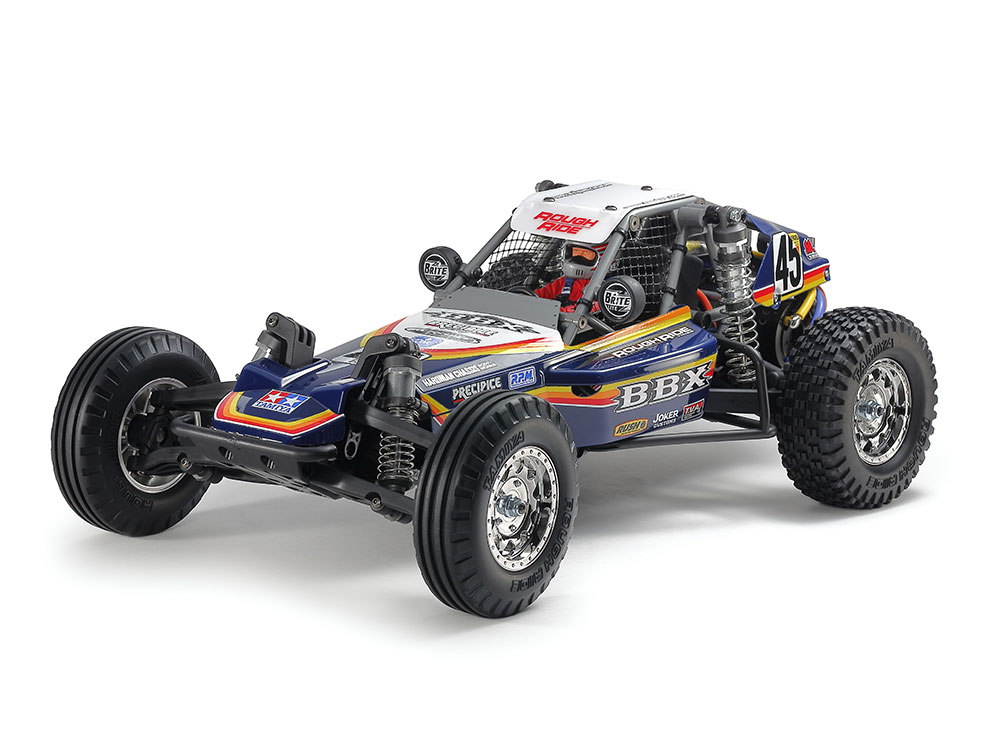
The Tamiya BBX is dangerous if you’re the sort of person who finds a neatly laid-out bag of RC parts strangely relaxing. One look and suddenly you’re clearing the workbench, researching paint and explaining that building it counts as an activity rather than another purchase. A very useful distinction. Legally untested.
SPEED / PACE
Your setup
Kit: speed depends on motor, battery and gearing.
RC TYPE
RC Build / Buggy
Choose the vehicle for the way you drive.
WHY IT STANDS OUT
Build it
A 2WD RC kit with real character
Hero image: Tamiya. Manufacturer product photography; colours and supplied equipment can vary.
This is a rear-wheel-drive buggy kit, so the building belongs in the enjoyment. If you just want to charge a battery and drive, a ready-built model may suit you better. If watching a box of components gradually become your own car sounds like a cracking evening, pull up a chair.
The box is the beginning
The BBX is Tamiya item 58719 on the rear-wheel-drive BB-01 chassis. It measures 414 mm long with a 283 mm wheelbase, uses a ball differential and combines front double-wishbone suspension with rear trailing arms. Tamiya specifies aluminium oil dampers and a 12.42:1 ratio with the supplied 18T pinion. A motor, ESC, radio equipment, low-profile servo, battery and charger are separate requirements.
There’s no single honest top speed for a kit without a fixed motor and battery combination. “Your setup” is the useful answer here. One owner’s fast BBX tells you about that build, not what every box of BBX parts is destined to become.
The kit price is only the start of the project total. Add the electronics, battery, charger, finishing materials and any tools you need. Do it before ordering rather than practising selective arithmetic and discovering the missing half of the budget later.
What a published build can teach you
RC CARS 2026 · THE RCNEWS SHORTLIST
RC terms used in this guide: ready-to-run (RTR) means the model is assembled; check which equipment is supplied. An electronic speed controller (ESC) controls motor power. LiPo means lithium-polymer battery, and the S number describes cells in series. Kv is approximate unloaded motor revolutions per minute per volt, not vehicle speed.
Researched RC buying guide. RCnews has not tested this vehicle hands-on. Manufacturer specifications and published reviews were checked on 6 September 2026.
Hero image: Tamiya . Manufacturer product photography; colours and supplied equipment can vary.
SPEED / PACE
Your setup
Kit: speed depends on motor, battery and gearing.
RC TYPE
RC Build / Buggy
Choose the vehicle for the way you drive.
WHY IT STANDS OUT
Build it
A 2WD RC kit with real character
The Tamiya BBX is an RC buggy kit for people who want to build the car as well as drive it. The kit price is only the starting point: you need compatible electronics, a battery, charger and finishing supplies. Planning those together is easier than discovering halfway through the build that the servo you bought will not fit.
Its desert-buggy shape gives the project a clear personality. You can picture the finished car while working through the smaller assemblies, and every completed stage brings it closer. If that sounds like a pleasant way to spend an evening, the BBX could be more rewarding than a faster car that arrives fully assembled.
Browse all ten RC cars for 2026 →
That’s why a build review can be more useful than a speed clip. You get to see the choices, the packaging and the awkward bit the finished body conveniently hides. Look for the practical explanation as well as the attractive final photograph.
Read the step before inventing your own
Set out the parts for the assembly you’re working on. Read the whole step, identify the fasteners and tighten things as instructed. Emptying every bag onto the table might look efficient for about twelve seconds, after which you’re running a small and poorly labelled hardware shop.
Give yourself sensible stopping points. A calm half-hour on an assembly can be more enjoyable than staying up late determined to finish, then discovering you’ve installed something backwards. The car doesn’t know what day you promised yourself it would be ready.
Photograph the stages as you go. You’ll appreciate a record of cable routing later, and it’s satisfying to see the thing take shape. Keep the manuals and component details together too. Future you has enough problems without trying to identify an ESC from a photograph of one corner of its sticker.
Electronics should fit each other, not just the wish list
Start with Tamiya’s requirements and the available space. The low-profile servo requirement is a real fit question, not a polite suggestion for people who happen to have one. Check dimensions before paying for a standard-height unit and then staring at it with disappointment.
Choose the motor, controller, battery and connections as a system. Individually lovely components don’t become a lovely installation by being put in the same shopping basket. Plan where they go and how the wiring will be routed without fouling anything.
Be honest about the intended driving. If you fancy relaxed runs and enjoying the buggy’s character, choose around that. There’s no obligation to create the most violently powered BBX on the internet. You can finish a project without turning the first test into a referendum on every component’s strength.
The paint scheme can be yours
You’re allowed to choose a simple finish. You’re also allowed to spend an unreasonable amount of time choosing between two shades nobody else can tell apart. Both are established RC traditions.
Check paint compatibility and prepare the body properly. The materials matter more than confidence. Take your time with masking and plan the design before opening anything, so a good idea doesn’t become an improvised solution to a paint mistake.
Think about how you want to use the finished buggy. A detailed shelf-focused build and a straightforward runner are different projects, and neither needs permission from the other. If you want to drive it regularly, choose a finish you’ll enjoy seeing out in the world rather than one that makes every pebble feel like a personal threat.
The first movement is still a big deal
Follow the radio and speed-controller setup instructions, check steering direction and travel, and sort the basic adjustments on the bench. A newly built model deserves a careful check even when you understand every part of it. In fact, knowing how much you’ve just assembled is a very good reason to check.
Give the first outing a modest shakedown. A few gentle passes, a stop and an inspection tell you more than immediately asking the whole build to prove itself. If something needs adjustment, that’s part of finishing the job—not evidence that the project has failed.
The first time it moves under its own power is a satisfying little moment. You’ve gone from bags of bits to a machine you can steer. It may be a small buggy, but you’re allowed to feel a bit chuffed. Just try not to deliver the full build history to the first passer-by unless they look genuinely interested.
Keep a useful record of your own BBX
Write down the motor, gearing, radio equipment and battery you chose. If you later alter something, you have a starting point rather than relying on memory and a series of increasingly uncertain guesses.
Try changes on familiar ground and make them one at a time. If you can describe what you want to improve, you can judge whether the change did it. If the aim is merely “more”, you may end up with more spending and less understanding.
Our take: the BBX is for someone who wants the whole project, from opening the bags to learning the finished buggy. Plan the installation, enjoy the finishing and let the first runs teach you what comes next. The build is not an obstacle between you and the hobby. For a kit person, it’s the bit where the evening disappears and the tea goes cold.
RC terms used in this guide: ready-to-run (RTR) means the model is assembled; check which equipment is supplied. An electronic speed controller (ESC) controls motor power. LiPo means lithium-polymer battery, and the S number describes cells in series. Kv is approximate unloaded motor revolutions per minute per volt, not vehicle speed.
Guide basis: manufacturer specifications and attributed published reviews, checked on 6 September 2026. This is not a comparative hands-on RCnews test.
RC technical specifications
| Specification | Detail |
|---|---|
| Model | Tamiya BBX / 58719 |
| Chassis / scale | BB-01 / 1/10 |
| Drive | Rear-wheel drive |
| Dimensions | 414 × 233 × 136 mm |
| Wheelbase | 283 mm |
| Differential | Ball differential |
| Suspension | Front double wishbone; rear trailing arms |
| Dampers | Aluminium oil dampers |
| Standard ratio | 12.42:1 with supplied 18T pinion |
| Required equipment | Motor, ESC, low-profile servo, radio, battery, charger and finishing supplies |
Source: official product specification. Check the exact model code, UK availability and retailer package before ordering. Prices are not fixed in this guide.
Fancy a closer look at the RC kit?
CompetitionX: Tamiya BBX build and driving review ↗
Different RC jobs call for different cars. This selection includes established models available for 2026; it is not a ranking or a claim that they all launched this year. Older reviews are labelled by generation.
More RC buying guides · Find UK RC clubs · Explore RC Insights