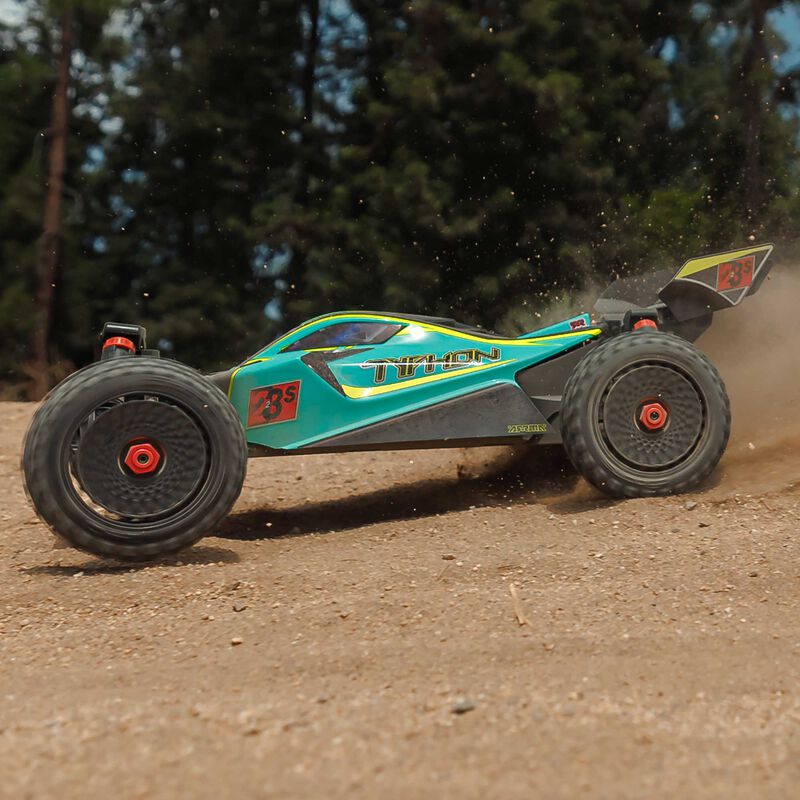
The ARRMA Typhon 223S is an RC buggy for the moment you discover that corners are quite good fun, actually. Not just the inconvenient bits between opportunities to flatten the trigger, but something you can practise, improve and become slightly unreasonable about on the journey home.
SPEED / PACE
50+ mph
ARRMA claim on 3S; 35 mph quoted on 2S.
RC TYPE
RC Buggy / Basher
Choose the vehicle for the way you drive.
WHY IT STANDS OUT
2S → 3S
Two power levels, one RC buggy
Hero image: Horizon Hobby / ARRMA. Manufacturer product photography; colours and supplied equipment can vary.
“One more lap, I’ve nearly got that bend.” Famous last words. Somewhere there’s a battery wondering how many more laps you think it contains. The attraction of a buggy is that a familiar route can keep giving you a new little problem to solve without needing a bigger ramp every week.
Full-size Typhon. Different from the Grom.
We’re covering the 1/8 Typhon 223S, ARA4306V4. That’s the full-size model, not the smaller Typhon Grom. Mixing their reviews and measurements creates a shopping list with the internal consistency of a shed drawer. Save the exact number before comparing anything.
The official specification supports both 2S and 3S LiPo power. ARRMA quotes 35 mph on 2S and 50+ mph on 3S. It lists a 3100Kv brushless motor, an 80A combined controller and receiver with Dynamic Stability Control, and an SLT3 radio. You supply the driving battery and charger. The technical panel uses this exact model’s manufacturer listing.
Leave your thumbs some thinking time
The two supported battery levels give you flexibility. More performance being available doesn’t mean you’re obliged to use it, any more than owning a whole bottle of chilli sauce means dinner needs an incident report.
Start with a pace that lets you choose where the buggy goes. You’ll get more out of the suspension and steering when you’re paying attention to a line, instead of trying to locate the vehicle after a brief and enthusiastic disappearance.
Pick a broad turn and aim for the same exit. Then add another corner. You’ll soon discover that going into the first one slightly slower can make the whole sequence work better. It feels suspiciously like getting better at something, which is always a pleasant surprise when the original plan was simply to muck about with a car.
What the test coverage tells us
RC CARS 2026 · THE RCNEWS SHORTLIST
RC terms used in this guide: ready-to-run (RTR) means the model is assembled; check which equipment is supplied. An electronic speed controller (ESC) controls motor power. LiPo means lithium-polymer battery, and the S number describes cells in series. Kv is approximate unloaded motor revolutions per minute per volt, not vehicle speed.
Researched RC buying guide. RCnews has not tested this vehicle hands-on. Manufacturer specifications and published reviews were checked on 6 September 2026.
Hero image: Horizon Hobby / ARRMA . Manufacturer product photography; colours and supplied equipment can vary.
SPEED / PACE
50+ mph
ARRMA claim on 3S; 35 mph quoted on 2S.
RC TYPE
RC Buggy / Basher
Choose the vehicle for the way you drive.
WHY IT STANDS OUT
2S → 3S
Two power levels, one RC buggy
The ARRMA Typhon 223S is a full-size RC buggy for drivers who enjoy linking corners and improving a line. It offers a choice of supported battery setups, but you do not have to use the fastest one to enjoy it. Check your usual surface first, and ask your club about eligibility if you are buying specifically to race.
First, a naming trap worth avoiding: this article covers the full-size 1/8 Typhon 223S, model ARA4306V4. It is not the smaller Typhon Grom. Both names appear in searches, and mixing their measurements, battery requirements or reviews would give you a very confused shopping list.
Browse all ten RC cars for 2026 →
A dramatic crash video can be entertaining without becoming a universal durability score. Watch the setup, surface and actual impact, rather than treating the outcome as proof that every Typhon is either indestructible or made of biscuits. The useful answer tends to contain more detail than either of those options.
Race-buggy shape, local-club rules
If you want organised racing, ring the club before buying for a particular class. Ask about batteries, tyres, dimensions and electronic assistance. A buggy silhouette is not an entry form, however confidently you can imagine it on the grid.
A visit is worthwhile. Watch the cars, see how the meeting runs and ask what a newcomer should bring. Notice how stopped cars are retrieved and when it’s safe to enter the circuit. Knowing the routine makes a first visit much more relaxed than guessing it while everybody else looks busy.
There’s no need to turn up pretending you’ve been doing it for twenty years. “I’m thinking of getting into this” is a perfectly useful opening line. You may discover the Typhon fits what the club offers, or another model has better local support. That’s exactly the sort of information you want before the delivery van turns up.
Your local ground gets a vote
A buggy can look fantastic in a prepared setting and still be the wrong choice for your usual patch. Walk the route and notice the ruts, stones and grass height. Your shoes can stride over things the model has to work through.
Long, rough grass is a different job from firm ground where the buggy can flow between turns. Buy for the place you’ll use regularly, not the ideal track you visit once in a very optimistic daydream. If your terrain points towards a monster truck, have that comparison honestly.
On a suitable route, use soft markers and keep the early layout simple. Too many corners too close together can make everything feel frustrating before you’ve learned the car. There’s no requirement to recreate a championship circuit between two trees and a patch of nettles.
The setup notebook nobody needs to see
Write down the battery, surface and settings you used. If you change something, make it one thing and try the same route again. That turns an impression into a useful comparison instead of an expensive guessing game.
Sometimes the improvement will be your driving. This is awkward for the part of the brain that wanted an excuse to buy shiny components, but excellent for the wallet. A calmer steering input costs nothing and is considerably easier to fit than a new front end.
If the model feels different, inspect it before diving into adjustments. A loose part or accumulated muck isn’t a tuning preference. Work from a known, healthy setup so you aren’t adjusting around a fault and calling the result “custom”.
What belongs in the first order?
Include the correct battery, compatible charger and the completion items listed for your exact package. Check fit, connector and battery retention against the manual. Hardcase doesn’t mean a pack can rattle around happily; it still needs to sit securely where it belongs.
Look up routine spares and save the manual on your phone. You don’t need to buy every part in advance, but knowing how to identify an arm or shock assembly is handy when several generations share the Typhon name. Guessing from a tiny product photograph is a hobby within a hobby, and not the enjoyable sort.
Keep a little budget for wear and maintenance rather than using the whole lot on speculative upgrades. You’ll make better choices once the car has had a few outings and you know what you actually want from it.
Our take on the Typhon
If you want a full-size buggy, have suitable ground and enjoy the idea of linking tidy corners, the 223S gives you an interesting setup to investigate. If racing is the plan, get the club’s answer first. If casual driving is the plan, you’re allowed to keep it casual.
The best progress might be five clean laps and a corner that finally makes sense. No podium required. You can still give a lengthy technical explanation in the car afterwards, of course. Whether your passenger requested one is a separate matter.
RC terms used in this guide: ready-to-run (RTR) means the model is assembled; check which equipment is supplied. An electronic speed controller (ESC) controls motor power. LiPo means lithium-polymer battery, and the S number describes cells in series. Kv is approximate unloaded motor revolutions per minute per volt, not vehicle speed.
Guide basis: manufacturer specifications and attributed published reviews, checked on 6 September 2026. This is not a comparative hands-on RCnews test.
RC technical specifications
| Specification | Detail |
|---|---|
| Model | Typhon 223S BLX / ARA4306V4 |
| Scale / drive | 1/8 / four-wheel drive |
| Motor | 3100Kv brushless |
| ESC / receiver | Spektrum SLT 80A 2-in-1 with DSC |
| Radio | Spektrum SLT3 |
| Servo | Spektrum S662 metal-geared |
| Battery | 2S or 3S hardcase LiPo |
| To buy separately | Battery, compatible charger and charging bag |
Source: official product specification. Check the exact model code, UK availability and retailer package before ordering. Prices are not fixed in this guide.
Fancy a closer look at the RC kit?
Elefun: Typhon 223S winter test ↗
First-run Typhon 223S bash test ↗
Different RC jobs call for different cars. This selection includes established models available for 2026; it is not a ranking or a claim that they all launched this year. Older reviews are labelled by generation.
More RC buying guides · Find UK RC clubs · Explore RC Insights