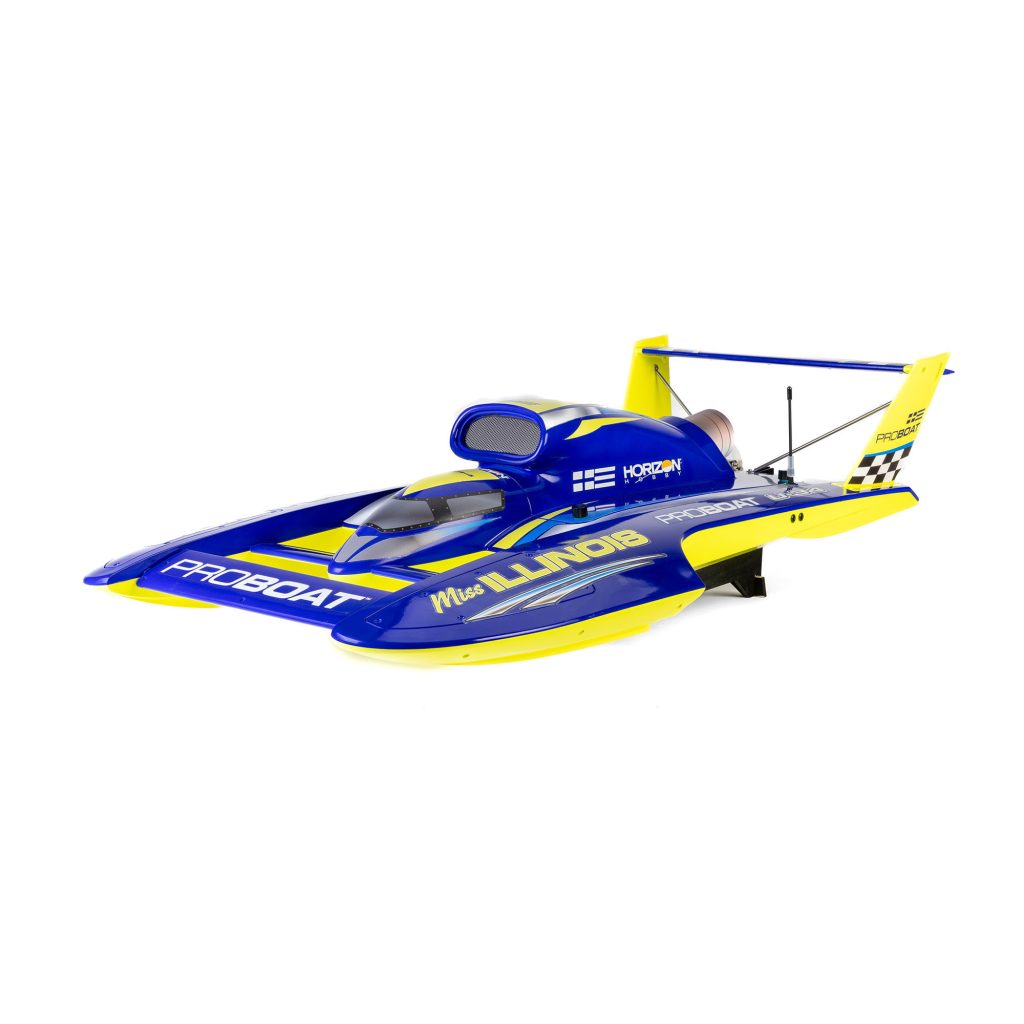
The Pro Boat Miss Illinois U-34 is appearing in retailer listings as a 34-inch ready-to-run RC hydroplane. If your RC browsing normally stays on dry land, this is the sort of boat that might have you checking where the nearest suitable lake is. Because apparently owning things that get stuck in trees wasn’t enough: now you fancy something that can stop in the middle of a lake. The hobby does like to keep our problem-solving skills fresh.
The PRB-2072T1 retailer listing identifies a brushless electric model with race-boat styling. This is coverage of the listed product, not a confirmed UK launch-date announcement. We haven’t run this boat, established local delivery dates or measured its speed. Confirm the current price, complete package and equipment requirements with the retailer before ordering.
A different sort of RC day out
Hydroplanes have a different hull layout from the conventional V-shaped boat many people picture first. That difference is part of the attraction, but it also means you should learn the setup and handling guidance for this particular model. Familiar sticks or a familiar trigger don’t make all hulls behave alike.
If you’re coming from cars, some habits transfer nicely: careful setup, an eye for loose hardware and the ability to become deeply interested in a tiny adjustment. Other parts of the outing change completely. You can’t walk over and put a boat back on the racing line the way you might retrieve a stopped truck.
That makes the venue a much bigger part of the buying decision. The photograph can tell you whether you like the look. It can’t tell you whether your local water allows this type of model, or whether you can launch and recover it there. Sort that out while the purchase is still a browser tab.
Find the right water first
Speak to the venue operator or a local RC boat club about powered models. Permission for model sailing doesn’t necessarily include fast electric boating. Ask about the operating area, other users and the agreed recovery arrangements.
It’s a useful conversation, not a test you have to pass by already knowing everything. Club members can explain the practical details that don’t make it into a glamorous product photograph: access from the bank, where to stand, how conditions change and what they bring along.
Keep swimmers, wildlife and other water users clear. If a boat stops away from shore, use the venue’s established recovery method; don’t enter the water to fetch it. That part is straightforward advice, not a challenge to improvise. A good recovery plan belongs in the outing before the first battery goes in.
Ready-to-run still needs a read-through
RTR, or ready-to-run, describes the supplied model. It doesn’t mean every listing includes every item you need. Check the required battery arrangement, charger and completion equipment against the exact version and manual.
If you already own RC cars, resist the urge to call a truck battery “probably fine” because the connector looks familiar. Voltage, dimensions, installation and the manufacturer’s requirements all matter. Matching one plug is a start, not the entire application process.
Battery capacity, usually shown in milliamp-hours (mAh), also isn’t a promised runtime. The load and throttle use affect how long a pack lasts. Plan an early return to shore during your first runs instead of trying to squeeze out a final minute at the far end of the water. The walk back from an RC session should involve your model, not a long-distance staring contest with it.
Learn the boat before chasing the number
We’re deliberately not attaching an unverified speed figure to the Miss Illinois. A number without a confirmed setup can turn into a promise the product information never made. What matters first is whether the model suits your water, equipment and experience.
Use the manual’s setup procedure and get to know the steering at a manageable pace. Give turns plenty of room and make the first run short enough to come back and inspect the installation. Check for water where it shouldn’t be, and investigate anything unexpected before another outing.
Where water cooling is fitted, follow the model’s specific checks for the cooling circuit. A blocked or disconnected line is something to fix, not something to ask another battery to sort out. The bank is a much better workshop than the middle of the lake.
Ask the questions that make ownership easier
When talking to experienced boaters, ask about the routine after a session, access for maintenance and which spares they actually keep. “What do you wish you’d known before your first run?” can produce a more useful answer than “how fast is it?”
You might discover that the model you wanted suits your plans nicely. You might discover that a different hull or size would get used more often. Either way, that’s progress. RC purchases are a lot more satisfying when the excitement survives beyond unboxing day.
The Miss Illinois has enough visual character to start that conversation. Once the exact package and suitable water are sorted, the next interesting part is learning what it’s like to operate. We’re all for a new RC obsession. We’d just like it to come with somewhere to run and a reliable way of bringing it home.